
Battery Depth of Discharge (DoD): Meaning and Accurate Calculation
10/21/2026 · 4 min read
Learn what battery Depth of Discharge (DoD) is, how to calculate usable capacity, and the impact of DoD on solar battery lifespan with SVP Solar experts.
Battery Depth of Discharge (DoD): Meaning and Accurate Calculation
When investing in a solar energy storage system, users often only focus on nominal capacity while overlooking that the actual amount of energy safely usable largely depends on the Depth of Discharge (DoD). Thoroughly understanding this metric not only helps you accurately estimate backup power duration for your home, but also protects the long-term lifespan of your storage system.
At SVP Solar (SAO VIET PHAT INVESTMENT CO., LTD), we always advise customers to carefully examine the technical specifications of energy storage batteries before installation to optimize both cost and operating efficiency.
What Is Depth of Discharge (DoD) and How Does It Differ From SoC?
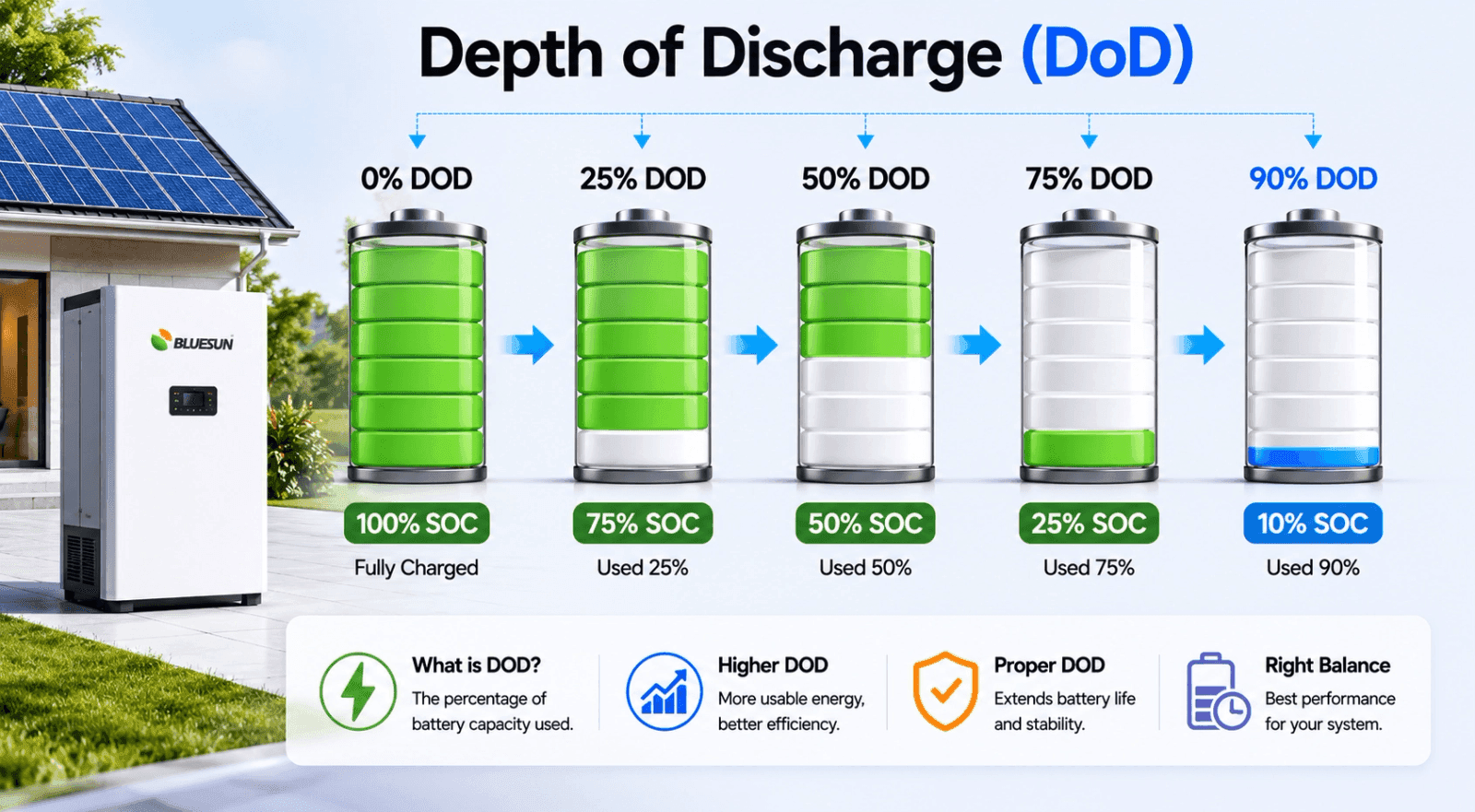
Depth of Discharge (DoD) indicates the percentage of energy that a battery has discharged relative to its total nominal capacity. If a battery is fully charged to 100% and then discharges 80% of its capacity, the DoD at that point is 80%.
Many users easily confuse DoD with SoC (State of Charge). In fact, these are two opposite sides of the same capacity state when starting from a full charge:
-
SoC (%): The percentage of remaining energy in the battery.
-
DoD (%): The percentage of energy discharged from the battery.
-
Relationship: When the battery begins discharging from 100% full, the relationship is expressed as: SoC (%) = 100% − DoD (%).
For example: If the inverter display indicates a remaining capacity (SoC) of 20%, it means the battery bank's current Depth of Discharge (DoD) has reached 80%.
Formulas for Calculating DoD and Usable Capacity
To determine exactly how much electrical energy your system can safely deliver, you can apply the following standard formulas:
1. Actual DoD Formula
$$\text{DoD (%)} = \left(\frac{\text{Discharged Energy (kWh)}}{\text{Total Nominal Capacity (kWh)}}\right) \times 100$$
(A similar formula applies when calculating in Ampere-hours (Ah): divide used Ah by total rated Ah).
2. Usable Energy Formula
$$\text{Usable Energy (kWh)} = \text{Nominal Capacity (kWh)} \times \text{Recommended DoD Limit (%)}$$
Practical example: A Lithium LiFePO4 battery pack has a nominal capacity of 10 kWh with a recommended maximum DoD of 90%. The actual usable energy available per cycle is: $$10\text{ kWh} \times 90% = 9\text{ kWh}$$
The remaining 1 kWh (10% SoC) is reserved by the Battery Management System (BMS) as a safety buffer to prevent deep over-discharge that could damage the battery cells.
Impact of Depth of Discharge (DoD) on Battery Lifespan
Not all battery chemistries possess the same tolerance for deep discharging. Deeper discharge cycles exert greater chemical stress on electrodes, electrolytes, and separators:
-
Flooded Lead-Acid Batteries: The recommended DoD should stay within $\le 50%$. Regularly discharging beyond 50% causes severe plate sulfation and drastically reduces cycle life.
-
AGM / Gel Batteries: The safe discharge threshold ranges between 50% and 70%, but these are still sensitive to frequent deep draining.
-
Lithium Iron Phosphate (LiFePO4): This is currently the most popular modern storage technology for residential solar power systems. LiFePO4 batteries allow a Depth of Discharge (DoD) of 80% to 95%, with some premium models supporting 100% discharge under rigorous BMS supervision while still providing thousands of durable cycles.
Ambient Temperature and Battery Operational Notes
In addition to DoD, the ambient operating temperature is a critical factor in determining the aging rate of a battery bank:
-
High temperatures (> 30°C): Accelerate unwanted chemical side reactions within the cells, shortening operational lifespan even under shallow discharge cycles.
-
Low temperatures (< 0°C): Increase internal resistance, hinder charge/discharge efficiency, and risk micro short circuits during fast charging.
Therefore, we consistently recommend installing battery storage cabinets in dry, well-ventilated spaces protected from direct sunlight to maintain the optimal operating temperature range (from 20°C to 28°C).
A properly configured battery storage system not only maximizes nighttime self-consumption but also guarantees total home safety. Based on actual load demand and detailed site assessments, the engineering team at SVP Solar will recommend the ideal nominal capacity and configure optimal DoD thresholds for every project. Please contact us to receive a precise technical solution tailored to your home.