Latest Regulations on Peak Electricity Hours in 2026
10/21/2026 · 4 min read
Update on the latest regulations regarding peak and off-peak electricity hours in 2026 and effective electricity cost optimization solutions with SVP Solar experts.
Latest Regulations on Peak Electricity Hours in 2026
Electricity consumption demand in Vietnam has been setting new records year after year, driving significant adjustments in the operation of the national power system. In order to closely reflect real consumption patterns and optimize the load curve, regulatory authorities have issued updated guidelines for peak hours, off-peak hours, and standard hours. The article below by SAO VIET PHAT INVESTMENT CO., LTD (SVP Solar) provides detailed insights into these regulations along with effective adaptation strategies for large electricity consumers.
Background Behind the Adjustment of Electricity Time-of-Use Windows
According to data from the National Power System and Electricity Market Operator (NSMO), under the impact of widespread extreme heatwaves, national peak demand once surpassed the milestone of 54,650 MW, with daily consumption exceeding 1.15 billion kWh.
Notably, the modern power system's peak demand has shown a strong shift toward the late evening hours (from 17:30 onwards into the night). This is the period when residential activities, space cooling, and commercial service operations surge. Meanwhile, solar power generation subsides at sunset, and many small hydropower reservoirs face water inflow constraints. To alleviate dispatch pressure and minimize the need to mobilize expensive oil-fired generation units, restructuring the time-of-use electricity pricing windows is an urgent necessity.
Details of Peak and Off-Peak Hours Under the New Regulations
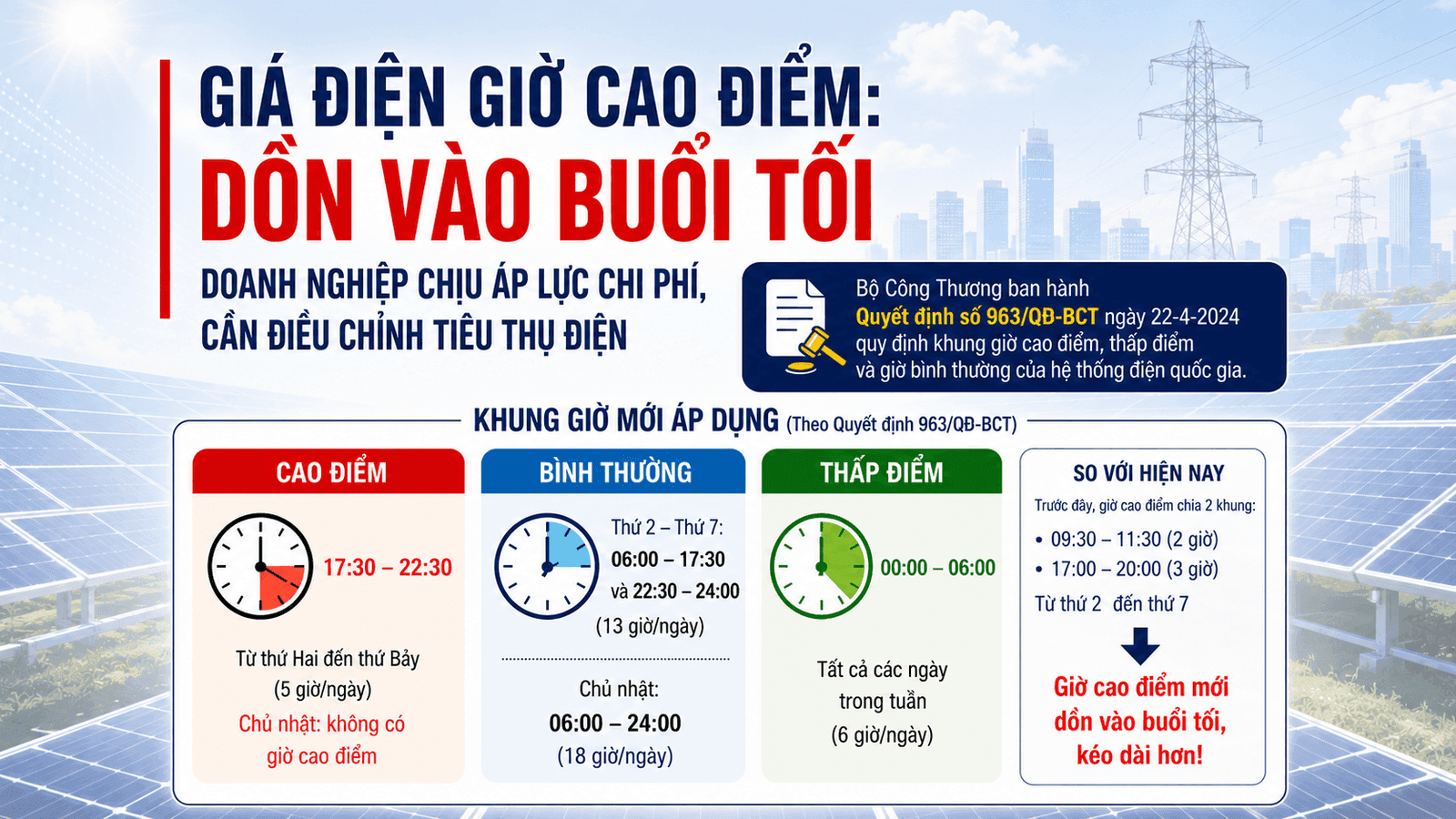
Based on Decision 963 of the Ministry of Industry and Trade issuing time frame regulations for the national power system and NSMO's practical operational proposals, the time slots are divided as follows:
-
Peak hours: Applicable from Monday to Saturday between 17:30 and 22:30 (totaling 5 hours per day). Peak hours do not apply on Sundays.
-
Standard (normal) hours: Applicable from Monday to Saturday across two time intervals: from 06:00 to 17:30 and from 22:30 to 24:00 (totaling 13 hours per day). On Sundays, standard hours apply continuously from 06:00 to 24:00 (18 hours per day).
-
Off-peak hours: Applicable every day of the week (Monday through Sunday) from 00:00 to 06:00 (totaling 6 hours per day).
This change means businesses are no longer subject to peak pricing during midday as in previous periods; however, the evening window becomes the highest-priced electricity tariff period of the day.
Reference Electricity Tariffs by Time-of-Use Windows
Currently, retail electricity tariffs based on time-of-use apply to commercial service customers and manufacturing sectors, differentiated by voltage level in accordance with Decision 1279/QD-BCT of the Ministry of Industry and Trade:
-
Commercial & service customers:
-
Voltage level below 6 kV: Off-peak is 1,918 VND/kWh, standard is 3,152 VND/kWh, peak reaches 5,422 VND/kWh.
-
Voltage level from 6 kV to below 22 kV: Off-peak is 1,829 VND/kWh, standard is 3,108 VND/kWh, peak is 5,202 VND/kWh.
-
Voltage level of 22 kV and above: Off-peak is 1,609 VND/kWh, standard is 2,887 VND/kWh, peak is 5,025 VND/kWh.
-
-
Industrial manufacturing customers:
-
Voltage level below 6 kV: Off-peak is 1,300 VND/kWh, standard is 1,987 VND/kWh, peak is 3,640 VND/kWh.
-
Voltage level from 6 kV to below 22 kV: Off-peak is 1,234 VND/kWh, standard is 1,899 VND/kWh, peak is 3,508 VND/kWh.
-
Voltage level from 22 kV to below 110 kV: Off-peak is 1,190 VND/kWh, standard is 1,833 VND/kWh, peak is 3,398 VND/kWh.
-
Voltage level of 110 kV and above: Off-peak is 1,146 VND/kWh, standard is 1,811 VND/kWh, peak is 3,266 VND/kWh.
-
The price difference between peak and off-peak hours can reach nearly three times, putting substantial financial pressure on enterprises operating continuously during evening shifts.
Adaptation and Cost Optimization Solutions from SVP Solar
Facing this shift, manufacturing and commercial facilities should proactively review their operational lines to minimize high-capacity equipment usage between 17:30 and 22:30. In addition, integrating renewable energy sources has become an inevitable trend.
At SVP Solar, we recognize that equipping a solar power system combined with a battery energy storage system (BESS) is the key to solving the challenge of the new electricity tariff structure. Solar power generated during the day not only meets self-consumption needs during standard hours but can also charge the storage batteries, or low-cost electricity can be purchased at night during off-peak hours, and subsequently discharged during the expensive evening peak window.
The actual reduction in electricity bills and payback period will depend on load size, installation space, and specific technical survey results. Feel free to contact the engineering team at SVP Solar for load measurement consultations and the most optimal energy solution for your business.