The Most Accurate Guide to Distinguishing Grade A and Grade B Battery Cells
10/21/2026 · 4 min read
A comprehensive guide to identifying Grade A and Grade B battery cells accurately through QR codes, internal resistance, and actual capacity. Partner with SVP Solar to select durable, safe energy storage batteries.
The Most Accurate Guide to Distinguishing Grade A and Grade B Battery Cells
When investing in a solar energy storage system, choosing genuine Grade A battery cells plays a crucial role in determining safety, charge-discharge efficiency, and the operational lifespan of the entire setup. However, the market is currently flooded with products labeled as Grade A that are actually factory seconds (Grade B) or recycled cells, causing confusion among consumers. In this article, SAO VIET PHAT INVESTMENT CO., LTD (SVP Solar) provides a precise technical perspective to help you clearly differentiate between these two types of battery cells.
What Are Grade A and Grade B Battery Cells?
In the manufacturing process of Lithium battery cells (especially the LiFePO4 chemistry widely used in solar storage), every cell undergoing chemical formation must pass rigorous factory testing regarding capacity, internal resistance (IR), mechanical dimensions, and self-discharge rates.
-
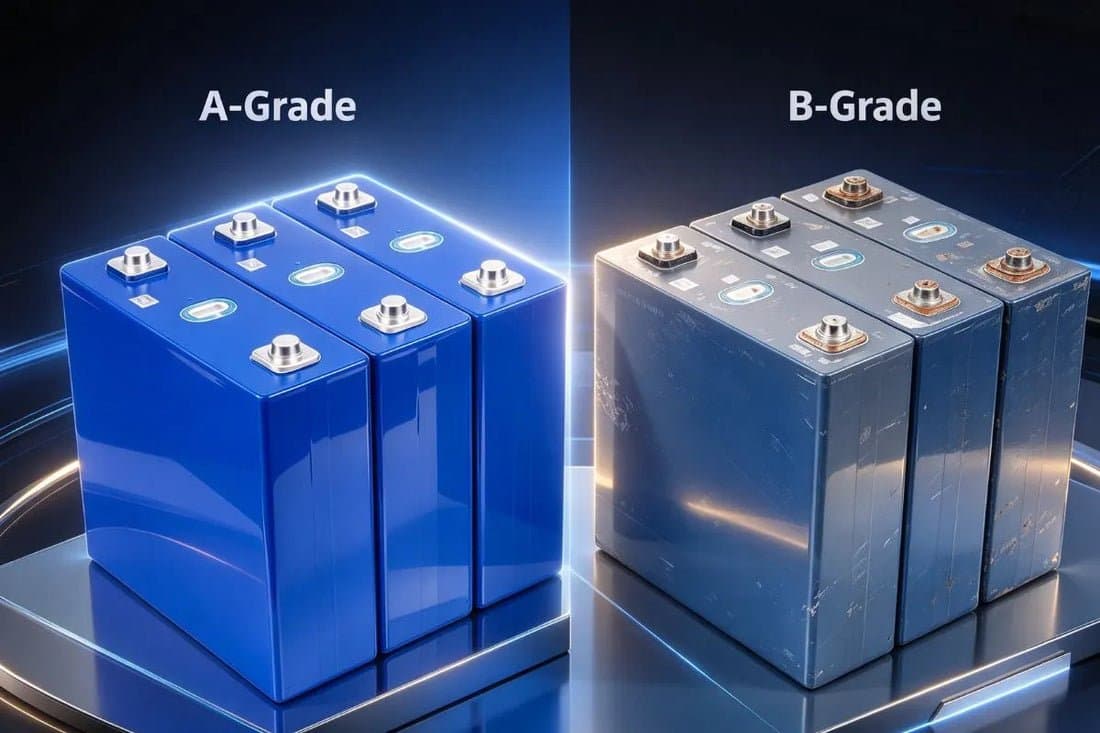
Grade A Battery Cells: These are cells that meet 100% of the manufacturer’s technical design specifications. The actual capacity typically equals or exceeds the nominal rating, internal resistance is ultra-low and perfectly consistent, the exterior casing is flawless, and they come complete with an original QR code and a Factory Test Report.
-
Grade B Battery Cells: These cells experience technical deviations during production. Their capacity may fall short by 2% to 5% compared to specifications, internal resistance may exceed standard thresholds, self-discharge rates may be higher, or they may exhibit minor aesthetic blemishes. Although still functional, these cells do not qualify for electric vehicles (EVs) or high-end energy storage systems requiring strict uniformity.
Why Are Grade A Battery Cells Superior to Grade B?
A solar energy storage battery pack is usually constructed by connecting multiple single cells in series (such as a 16S configuration for a 48V/51.2V system). The performance of the entire battery pack is limited by the weakest cell in the string (the "wooden barrel effect").
When using Grade B cells, discrepancies in internal resistance and capacity force the Battery Management System (BMS) to balance continuously. During high-power charging or discharging, inferior cells will hit full or empty states prematurely, triggering early cutoff cycles and drastically reducing the usable capacity. Conversely, genuine Grade A cells deliver exceptional consistency, generate minimal heat, and maintain durable charge-discharge performance across thousands of cycles without risk of premature swelling.
4 Practical Ways to Identify Grade A Battery Cells
To avoid purchasing refurbished or relabeled cells, you can apply the following inspection methods:
1. Inspect the Laser QR Code and Casing Appearance
Every Grade A cell from top-tier manufacturers (such as EVE, CATL, REPT, and Hithium) features a crisp, laser-engraved QR code on top of the cell or near the terminals. This code contains factory information, product lines, production dates, and a unique serial number.
For Grade B cells, manufacturers often laser off the original QR code or engrave a "B" over it to void the factory warranty. Dishonest suppliers frequently polish out these markings, re-engrave counterfeit QR codes, or apply new shrink-wrap sleeves to mislead buyers. Examine the metal surface surrounding the QR code closely: if you see grind marks, abnormal indentations, or smudged fonts, it is certainly not an original Grade A product.
2. Measure Actual Discharge Capacity (Capacity Testing)
A true Grade A cell must achieve at least 100% of its nominal capacity when tested under standard conditions (25°C ambient temperature, 0.5C or 1C discharge rate depending on datasheet specifications). In fact, many freshly produced Grade A batches yield an actual capacity that exceeds the label rating by 1% to 3%. If a nominal 280Ah cell tests at only 265Ah to 272Ah, it is very likely a Grade B cell.
3. Measure AC Internal Resistance and Check Uniformity
Static internal resistance should be measured using a dedicated 1kHz AC milliohm meter (such as the YR1035+). Grade A cells feature exceptionally low internal resistance with minimal variance across cells within the same batch (voltage difference < 5mV, internal resistance difference < 0.05mΩ). Grade B cells typically display erratic internal resistance, making long-term balance across a series string difficult to sustain.
4. Match Factory Test Reports with Serial Numbers
Reputable suppliers always provide factory testing datasheets alongside shipments. These reports detail every serial number paired with its factory-measured voltage, internal resistance, and automated test capacity. Simply scan the QR code on the cell and cross-reference it with this datasheet.
Expert Advice from SVP Solar
In reality, Grade B cells are not complete scrap; they can still be repurposed for low-demand, small DIY projects where high durability is not critical. However, vendors deliberately selling Grade B cells under the guise of Grade A at premium prices directly harms end users.
At SVP Solar, we are dedicated to absolute transparency regarding the origin and specifications of all equipment. Every energy storage configuration in our solar systems is engineered and recommended based on actual site load requirements, guaranteeing optimal performance and long-term durability. For in-depth technical consultation, please contact our engineering team for dedicated assistance.